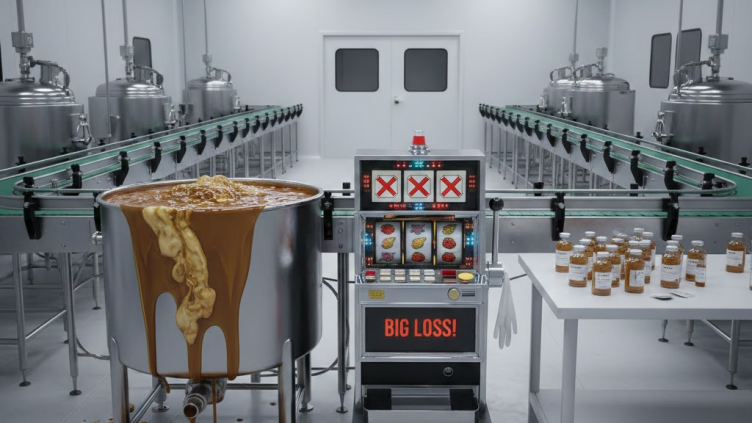
The modern R&D lab is often hailed as a bastion of innovation but in reality it functions more like a high-stakes casino where the house has rigged the slot machines against you. You walk in with a vision and a checkbook only to realize that the formulator is merely the gambler wagering with raw materials as chips while the stability chamber plays the role of the dealer who seems to win almost every single hand. We have somehow normalized a workflow in this industry that borders on insanity by accepting that we must physically mix and heat and pour dozens of failed prototypes before finding one that doesn't separate into a sad oily mess. We even accept the fact that we must wait months for accelerated stability data just to find out that the Vitamin C oxidized and turned your beautiful serum into something that looks like brown gravy.
If you look at the industry averages for bringing a new and complex natural product from brief to shelf you are looking of over 12 months. For a highly customized clinical formula that timeline can stretch to two years or more depending on the level of validation you need. In a digital world where trends shift overnight this is a glacial pace. To fix it we have to dissect the massive bottlenecks that are killing your speed to market and look at the actual cost of guessing your way to a product launch.
The Sourcing Void
Most founders operate under the mistaken belief that formulation starts when the chemist picks up a beaker but that is a lie. Formulation starts with the Paper Formula and this is where the first bottleneck strangles the project. In the traditional model a brand sends a brief for a peptide serum or a stress-relief gummy and the chemist then spends weeks sourcing raw materials while flying blind. They rely on Technical Data Sheets that claim these ingredients are stable but offer absolutely no data on how they interact with each other in a complex matrix.
Consequently you lose two months just waiting for ingredients to arrive only to mix them and realize they are chemically incompatible on Day 1. You effectively spend eight weeks preparing for a failure you could have predicted in eight minutes. This Sourcing Void burns significant operational runway before a single gram of product is even made.
The "Free" Formulation Trap
Many founders attempt to shortcut this process by hiring a Contract Manufacturer based on a low upfront formulation fee usually in the $3,000 to $12,000 range but this is almost always a financial trap. That low fee is simply an entry ticket to the casino. The hidden cost here is Intellectual Property. Unless you negotiate aggressively that low fee often means the manufacturer retains ownership of the formula. You are effectively paying for the privilege of being handcuffed to a single supplier who can raise prices or discontinue your line at will because you do not own the recipe to your own business. True custom formulation where you own the IP and account for necessary testing and manufacturing setup typically scales the total project budget to between $7,000 and $30,000+ per SKU. You are paying for the asset itself and not just the labor.
The Iteration Hell
The real physical grind begins only once the materials finally arrive. While a seasoned chemist might nail the texture of a standard synthetic formula in five to ten tries we are rarely dealing with simple synthetics. We are making high-potency natural wellness products and nature is inherently chaotic.
In the Nutraceutical space the primary enemies are taste and bioavailability. You might try to mask the bitter muddy taste of Ashwagandha or the sulfurous notes of NAC with Monk Fruit. It might work in version 12 but then the viscosity drifts and the liquid becomes too thick to pump. You fix the viscosity in version 25 but now the active ingredient precipitates out of the solution because of hygroscopic interactions.
In Skincare the enemy is the interface. You want a luxurious texture without using PEGs or silicones so you try a natural olive-derived emulsifier. It feels great in Version 3 but soaps or turns white upon application. You add a defoamer in Version 15 but it destabilizes the preservation system.
Often teams go through dozens of physical iterations for a single complex product. This isn't engineering. It is brute force. It burns thousands of dollars in raw materials and hundreds of hours of labor all because we are trying to solve physics problems by blindly mixing buckets.
The Stability Cliff
But the true killer of momentum is the Stability Cliff. Imagine that Version 45 finally feels perfect. You feel a massive sense of relief and put it in the Stability Chamber at 40°C/75% RH to simulate aging according to the industry bible known as ICH Q1A. Now you are powerless to speed up time and are forced to wait for the data. According to the guidelines you need data from a 6-month study for a full regulatory submission.
Then the phone rings. It is the lab telling you the emulsion cracked at Month 2. Your launch date is gone and you are explaining to investors why Q3 is empty while you go back to Version 1 to reformulate and restart the 6-month clock. In the natural space where we avoid robust synthetic stabilizers this Stability Cliff happens constantly. Brands often fail stability two or three times before launch which results in over a year of dead time where your capital is frozen and your market opportunity is shrinking.
The Invisible Wall
The final and perhaps most heartbreaking bottleneck appears just when you think you have succeeded. Many brands reach the end of a successful formulation cycle after spending $15,000 on R&D and months on stability only to receive the final production quote from the manufacturer. If your target Cost of Goods Sold was $2.50 to maintain a healthy retail margin but the perfect formula costs $8.00 to produce because of a high-cost Saffron extract or specialized liposomal delivery the project is dead on arrival.
You cannot simply swap an expensive ingredient at the last minute because that would restart the stability clock. This lack of early-stage financial modeling means that a significant portion of advanced projects fail at the quoting stage forcing a complete redesign. You must formulate to a price point from Day 1 rather than treating it as an afterthought.
How Beat the House
To fix this we must stop treating chemistry like a gamble and start treating it like a rigged game that we can beat. The way to beat the house is to move the failure from the physical world to the virtual world using a new category of software that operates as a Genius Virtual Chemist. This software counts the cards for you by combining three distinct superpowers.
The first superpower is the Expert Historian. Before a single molecule is modeled the system scans millions of clinical papers and patent databases to understand what has already happened acting as a guardrail against known failures. If you try to combine a specific peptide with a low pH acid the system flags the incompatibility immediately by citing the exact study where that combination failed.
The second superpower is the Logic Guard. This is distinct from history as it checks the fundamental physical requirements of every ingredient. The software scans the raw material data for solubility profiles and heat sensitivity and pH constraints to detect non-historical incompatibilities. If you attempt to place a water-soluble active into an anhydrous oil base without a carrier or if you heat a thermally sensitive vitamin above its degradation point the system flags this error instantly based on the physical rules of the raw material.
The third superpower is the Future Simulator. Once the historical and logical checks are complete we move to predictive physics. We use computational engines to digitally model the behavior of the remaining ingredients. We can simulate the Hydrophilic-Lipophilic Difference of the oil phase to predict exactly which surfactant structure will create a stable interface or run a Redox Potential simulation to see if the Turmeric will oxidize the Vitamin C before you ever order a sample.
By merging these three layers we create a validation loop. The Historian and Logic Guard ensure the formula is scientifically sound while the Simulator ensures it is physically robust. We can run 1,000 virtual iterations in a single afternoon and fail 999 times inside the computer so that when we finally go to the lab we are mixing the one formula that is chemically and historically validated. This cuts the prototype phase from dozens of versions down to a handful, transforming R&D from a casino into a sniper rifle.
References
Sources: Institute of Personal Care Science. (2025). 5 Tips to Cosmetic Product Launch Success. Personal Care Science, 8(2), 12–15. Freelance Formulations. (2025). How Much Does it Cost to Manufacture a Skincare Product? Cosmetic Manufacturing Review, 14(1), 88–92. International Council for Harmonisation (ICH). (2003). Q1A(R2) Stability Testing of New Drug Substances and Products. Quality & Regulatory Standards, Section 2.2.7.1. QIMA Life Sciences. (2024). How in silico screening can guide product development in cosmetics. Computational Biology and Cosmetics, 11(3), 204–211. MSL Solution Providers. (2025). Who Owns the Formula? Intellectual Property & Contract Manufacturing Analysis, 19(5), 310.